
See the model behind the pitch
Compare current, broker and plan cases using the RV model’s defined inputs: transient site-nights, daily rates, seasonality and operating days. No booked-demand or seasonal-market data is inferred.
Pressure-test RV resort economics with supplied site-nights, rates, seasonality, costs, debt and downside—without inferring booked demand or market seasonality.
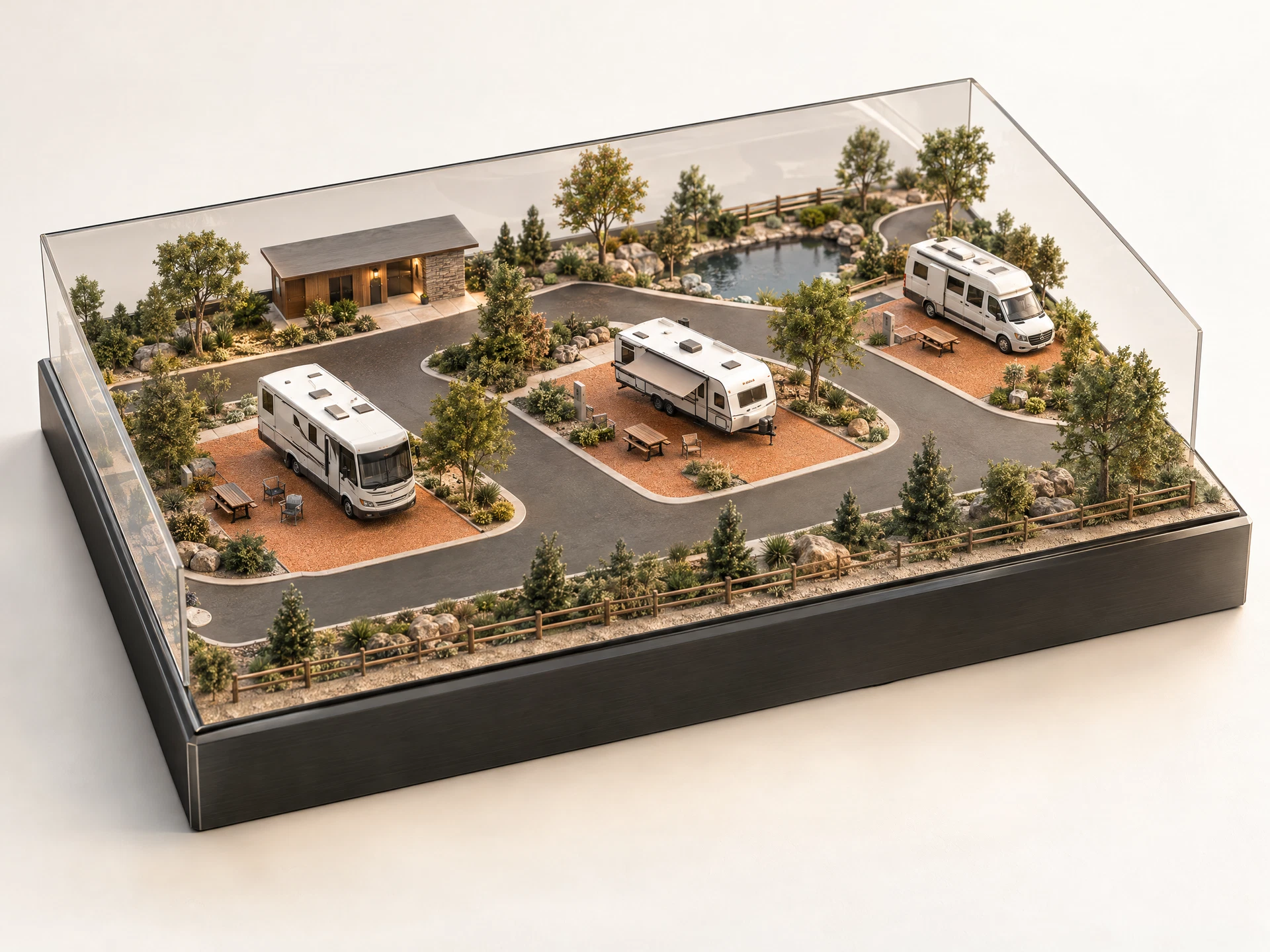 RV resortsConceptual product render
A polished broker package can still leave key questions unanswered: do transient site-nights, long-term sites and ancillary income cover the full operating and infrastructure burden—and how does the picture change against your plan or under downside assumptions?
The existing RV mode uses site-nights, daily rates, operating days and long-term sites—not apartment rent with a new label. Seasonality and ancillary revenue are user-supplied assumptions; booking or market data is not automatically sourced.
Keep the right inputs together so your team can spend more time evaluating the opportunity and less time reconciling versions.
Compare current, broker and plan cases using the RV model’s defined inputs: transient site-nights, daily rates, seasonality and operating days. No booked-demand or seasonal-market data is inferred.
Consider long-term sites and ancillary income alongside the full operating and infrastructure costs, so revenue assumptions are read in the context of the resort’s cost structure.
Review debt and downside scenarios as part of the same decision-support picture, rather than treating a headline revenue estimate as the whole story.
Bring what you have. Flag what is missing. A dated source is more useful than an unexplained assumption.
Operating calendar, seasonality assumptions and operating days.
Transient site-night assumptions and daily rates, with their source or rationale.
Long-term site assumptions and supporting ancillary-income detail.
Full operating and infrastructure cost schedules.
Current financials, broker materials and your plan, plus debt terms and downside assumptions.
Meaningful metrics, clear definitions. Set the baseline and review the assumptions—not just a headline score.
Shows the revenue implied by supplied transient site-night and daily-rate inputs; it does not imply bookings or infer demand.
Keeps these additional income streams visible as distinct model inputs alongside transient activity.
Frames a downside case against modeled operating and infrastructure costs and debt inputs; it is a scenario view, not a promised result.
Conceptual review outline only. It does not show a live model, prediction, calculation, or outcome.
Provide the current financial picture, broker materials and your plan, plus the operating, cost and debt inputs you want considered.
A fictional walkthrough of this audience’s review—not a customer testimonial or promised result.
No. The existing RV model uses supplied site-night, rate, seasonality and operating-day inputs. It does not infer booked demand or provide seasonal market data.
The existing RV and apartment tools are distinct models. Storage and flips are not built offerings here and would need separate scoping. Listing execution is also separate, not part of this RV model.
Pricing is based on custom scope; no fixed price is implied here. The work is decision support, not investment advice.
Tell us what you are buying, operating or trying to understand. We review the brief and agree the right module—or combination—for your goals.