
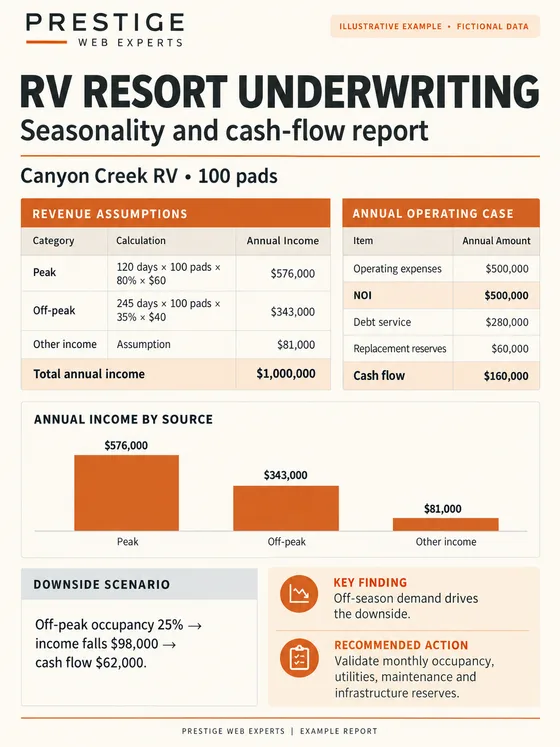
 Open example
 Illustrative example · fictional data
RV Resort Underwriting
Seasonality and cash-flow report
A fictional RV resort underwriting report that separates seasonal revenue, operating case and off-peak downside.Model transient site-nights and long-term sites separately, then test rates, occupancy, operating days, costs and debt.
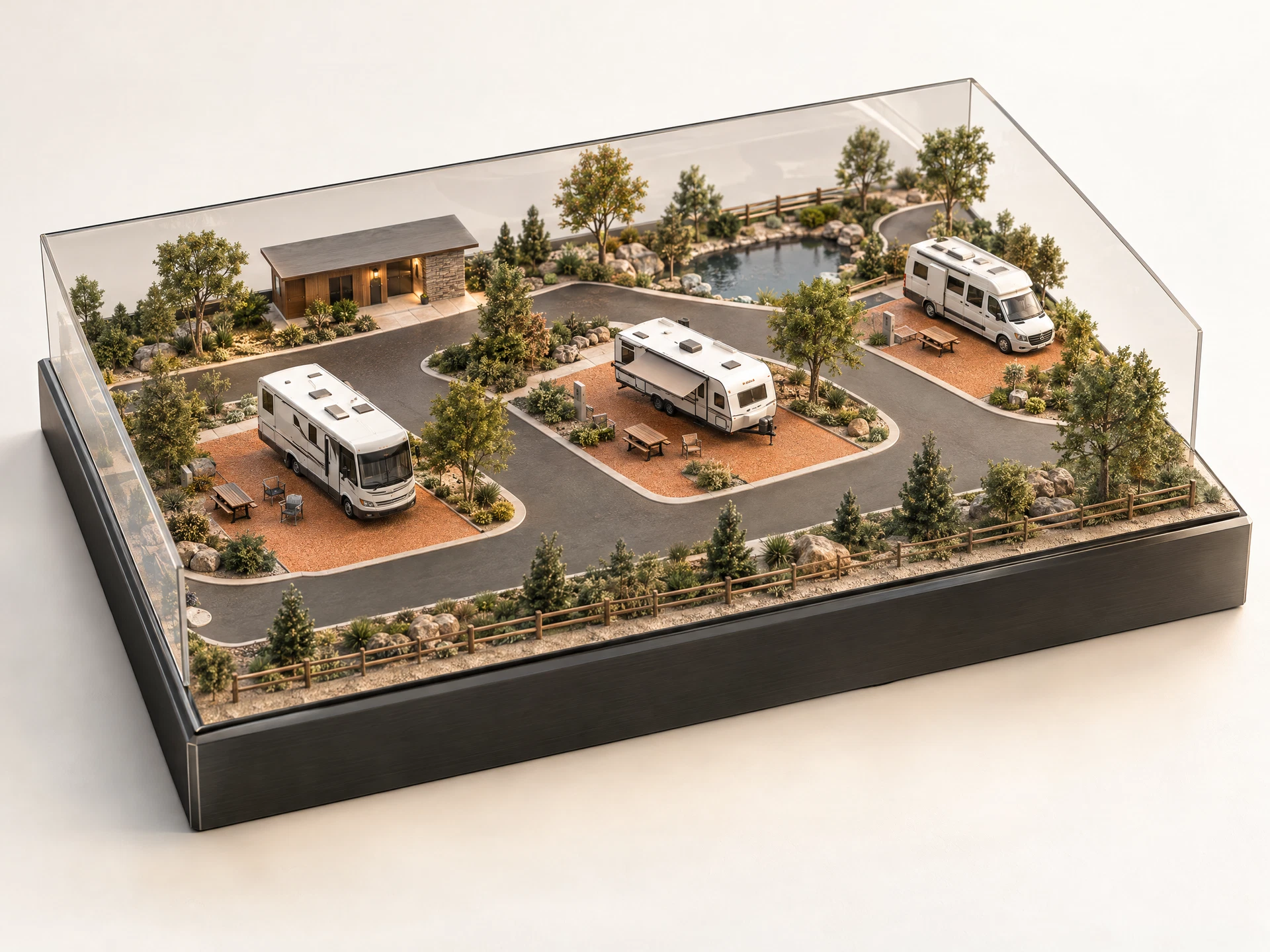 RV resortsConceptual product render
Open the completed example to see inputs, uncertainty and the next decision. It does not create an analysis, integration or customer entitlement.
Open example Seasonality and cash-flow report
A fictional RV resort underwriting report that separates seasonal revenue, operating case and off-peak downside.A busy holiday weekend is not a full-year operating case. Expose how site mix, seasonality and infrastructure costs affect the numbers.
The existing RV mode uses site-nights, daily rates, operating days and long-term sites—not apartment rent with a new label. Seasonality and ancillary revenue are user-supplied assumptions; booking or market data is not automatically sourced.
Start with the source material that matters to this property type. Agree the outputs and what is included before work begins.
Transient sites, daily rates and occupied site-nights
Season length and actual operating days
Long-term sites, monthly rents and occupancy
Documented ancillary income and full annual expenses
Water, septic, roads, amenities, reserves, financing and capital needs
Separate transient and long-term revenue
Current, broker and operating-plan cases
Cash flow, debt coverage and weighted break-even occupancy
Occupancy and cost sensitivity
Private saved reports using the existing provisioned tool
Meaningful metrics, clear definitions. Set the baseline and review the assumptions—not just a headline score.
Transient capacity actually represented in the entered annual case.
Income remaining after operating expenses, debt and replacement reserves.
Revenue-weighted capacity needed to cover the entered cost and debt burden.
Conceptual review outline only. It does not show a live model, prediction, calculation, or outcome.
Distinguish transient sites from long-term sites; record actual rate and occupancy evidence.
Buying the asset and operating it raise different questions. Follow the page that speaks to yours.
No. The existing RV model uses supplied site-night, rate, seasonality and operating-day inputs. It does not infer booked demand or provide seasonal market data.
The existing RV and apartment tools are distinct models. Storage and flips are not built offerings here and would need separate scoping. Listing execution is also separate, not part of this RV model.
Pricing is based on custom scope; no fixed price is implied here. The work is decision support, not investment advice.
No. The scope is an operating-planning view for occupancy, rate, and site-mix assumptions, seasonal margins, reserves, and infrastructure—not reservation automation or rate execution.
Existing apartment and RV tools are distinct from this audience narrative. This RV-resort scope centers on resort and campground operations; storage, flips, and listing execution are not built into it and would need separate scoping.
Pricing is based on custom scope. The requirements and available operating data are reviewed before a proposal is prepared.
Tell us what you are buying, operating or trying to understand. We review the brief and agree the right module—or combination—for your goals.