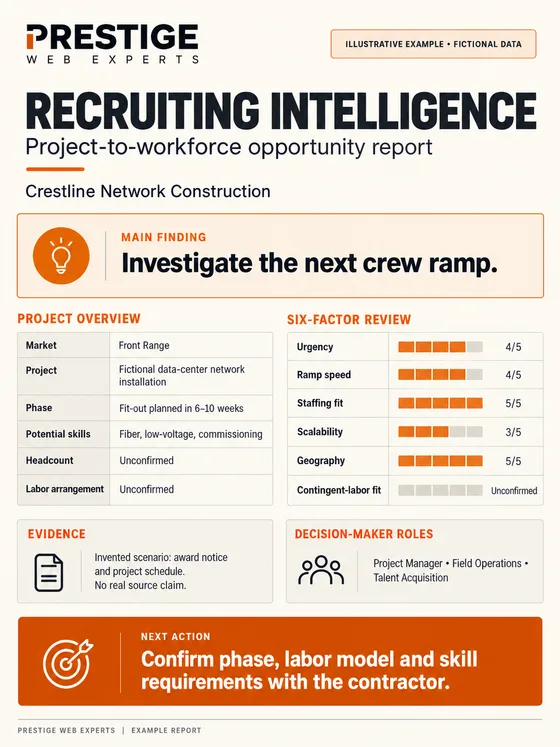
 Open example
 Illustrative example · fictional data
Recruiting Intelligence
Project-to-workforce opportunity report
A fictional workforce-signal brief with six fit factors, evidence limits and roles to investigate.Predict which data-center contractors may need skilled crews before public job requisitions appear—using permits, project awards and expansion signals.
Over $1M in revenue. Nearly 50 placements. Three data centers.Owner-reported outcome; supporting case pending. See the context Recruiting IntelligenceIllustrative product scene
These are completed fictional examples. The figures show assumptions and the next decision—not a live result, public price or automatic product run.
Open example Project-to-workforce opportunity report
A fictional workforce-signal brief with six fit factors, evidence limits and roles to investigate.Prestige’s owner reports that one recruiter used a project-led intelligence approach to focus on data centers, identify skilled-labor opportunities and reach the right conversations.
The owner-reported outcome is over a million dollars in revenue and nearly 50 skilled-labor placements across three data centers. It is not presented as an independently verified testimonial until a supporting case is approved for publication.
Build your opportunity briefPredictive recruiting connects evidence of upcoming work to the people needed to deliver it. Permits, awards and expansion can reveal likely hiring demand before an employer publishes a requisition.
Permitting and construction activity can reveal a project moving toward execution—before a public hiring campaign.
Electrical, low-voltage and infrastructure awards help identify which contractors may need to ramp field crews.
Hyperscale data centers, AI infrastructure and new markets create a reason to investigate upcoming workforce needs.
A growing subcontractor footprint or multi-site rollout can expose staffing pressure below the prime contractor.
Fiber, structured cabling and telecom expansion point toward specialized installation and commissioning work.
Hiring signals, reported shortages, compressed schedules and overtime dependency can strengthen the demand case.
Focus on U.S. electrical, low-voltage, fiber, telecom and data-center contractors and subcontractors in non-union, open-shop or mixed labor environments that may use contingent workforce solutions.
The opportunity is not just the data-center owner. It is the contractor responsible for delivering the next phase—and the subcontractor trying to put a qualified crew on site.
Tell us your staffing specialtyNon-union/open-shop and mixed-labor suitability are screened for your service model. If the labor arrangement is not supported, it is marked unconfirmed and checked before outreach.
Prioritize fast-moving, mission-critical projects with a plausible need for rapid field-labor scaling—not every company with “data center” in its description.
Each criterion is rated from 1–5: lower to higher fit or priority. Scores come with supporting reasons; unresolved evidence is flagged rather than treated as a pass. Staffing fit is customized to your business—such as Tech Plus's skilled-workforce positioning—not a generic staffing score.
How immediate is the workforce need supported by the evidence?
How quickly is the project likely to move from award to labor-intensive work?
Do the likely roles match your specialties, talent pool and delivery capability?
Is there potential beyond one crew—across phases, projects or locations?
Can you deliver qualified people in the locations where the work is happening?
Does the labor model and project pattern support temporary or project-based staffing?
A 1–5 score is an opportunity-prioritization tool, not a statistical probability, committed headcount or promise of a staffing contract.
Know what is happening, why your workforce may fit and who to approach. Every brief is tailored to your specialties, service territory and delivery capacity.
The contractor or subcontractor, project or expansion, location and the specific signal detected, with its source and date when available.
Likely skill categories, project phase and estimated workforce demand. Estimates are separated from verified requirements; unsupported headcounts stay unknown.
Non-union, open-shop, mixed or unconfirmed labor status and evidence for temporary or project-based staffing suitability.
A separate 1–5 rating for each criterion, with a reason and evidence gaps—not a made-up probability or a guarantee of hiring.
Operations, Project Management, Talent Acquisition, Field Operations and Construction Leadership; named contacts and professional contact information when available.
A concise executive-level message connecting the project signal to your skilled workforce capability, geographic reach and ability to scale.
Award plus geography plus crew fit gives a recruiter a relevant opening. Position your company as a scalable skilled-workforce partner that can help the contractor deliver—not as another vendor asking whether they are hiring.
We customize the roles, ramp-up language and outreach angle to your specifics. Contacts and messages are prepared for your review; a demand estimate is validated in the conversation.
That is the focus: connect project and expansion signals to likely labor needs before public requisitions appear. The timing advantage depends on available evidence and the project's stage. We distinguish an early demand hypothesis from a confirmed hiring requirement.
Both can provide signals, but this module prioritizes the contractors and subcontractors delivering electrical, low-voltage, fiber, telecom and data-center infrastructure. They may need temporary or project-based labor as work ramps.
Start with your ideal contractor profile, skills you can supply, locations you cover, labor-model requirements and crew capacity. Opportunity scoring and executive messaging are aligned to those specifics, not a generic list of businesses.
Prestige reports one recruiter generated over $1 million in revenue with nearly 50 skilled-labor placements across three data centers using this approach. That is a real customer case supplied by the business owner, not a promised or typical result for every recruiter.
New work creates staffing pressure. The same project-first logic can be calibrated to other industries—using their specific signals, role requirements and hiring timelines. The goal is an earlier, better-informed call, not a claim that every announcement means a vacancy.
The data-center customer result stays a data-center result. These are additional research applications to calibrate and validate—not seven more proven case studies.
Publicly announced capital project with an identifiable new or expanded fab/plant, corroborated by an award, permits, construction contract or site mobilization. Treat a preliminary incentive memorandum as an early signal only; qualify further as binding funding and project execution become observable.
Use a semiconductor phase model: site mobilization precedes tool installation and commissioning; production ramp drives technicians/operators and process/equipment engineering. Score higher when binding funding, permits, GC/PLA contract and procurement milestones align. Route asset-owner hires separately from GC/subcontractor demand; verify requisitions with hiring owners before outreach.
Check before qualifying: The cited Intel evidence is a non-binding preliminary-terms announcement, not a final award; projected jobs are not requisitions. Capital plans can slip, work may flow to contractors, and ramp needs may be met by existing staff or subcontractors. Never convert published job estimates into openings.
Use project-level execution evidence: final funding or financing close, or a signed EPC/utility award, paired with required permits and notice to proceed/mobilization for a named transmission, substation, renewable-generation, storage, or grid-upgrade build. A grant selection alone is an earlier watchlist signal, not a confirmed hiring trigger.
Prioritize executable, project-specific milestones (final funding/contract close, permits plus notice to proceed, EPC award and mobilization); align role mix to asset type and construction phase. Calibrate against earlier projects’ milestones and subsequent requisition dates; distinguish asset-owner/O&M hiring from EPC and subcontractor hiring, and treat postings as lagging validation, not proof.
Check before qualifying: DOE’s cited 2024 projects were selected to enter capacity-contract negotiations; selection or potential contract value is not final funding or notice to proceed. Projected jobs do not establish vacancies: incumbent crews, subcontractor sourcing, delays, and conditional funding can break the signal.
Publicly announced facility investment and active construction or commissioning, especially when the operator commits to staffing the site. An automated cold-storage opening is a documented example of facility-to-workforce demand—not evidence of current unposted vacancies.
Segment by ambient/cold storage, automation level, project stage, and direct-operator versus third-party model. Backtest milestones against employer requisition dates and fills; calibrate lead time per segment. The NewCold example links investment and jobs, but does not establish pre-posting timing.
Check before qualifying: A project announcement does not prove vacancies remain unposted. Separate asset-owner/operator hiring from subcontractor and integrator hiring; phased openings, existing staff, contingent incentives, and unexercised options can weaken the signal.
An operator’s board-approved, financed expansion with site control and permits—or executed construction/implementation award plus a dated commissioning/opening plan—is a high-signal trigger. Earlier announcements or land purchases alone are conditional; verify operator-side service activation and staffing-plan evidence to time pre-opening recruiting.
Score by phase: funded/approved plus construction mobilization = Strong for eventual operator-side staffing; announcement or land purchase with approvals pending = Conditional. Validate owner/operator versus contractor, staffed beds and services, commissioning milestones, staffing plans, and direct recruiting responsibility. Calibrate against that system’s prior openings: project milestones versus requisition publication and roles posted. Infer no headcount or fixed lead time.
Check before qualifying: Construction awards primarily signal contractor/subcontractor labor, not the hospital’s clinical requisitions; options, planning announcements, and approvals-pending projects may not be funded or proceed. Expansion may shift existing staff rather than add net roles. Examples demonstrate mechanisms only; neither cited organization is asserted to have unposted vacancies.
A new prime production/implementation award with defined deliverables and an explicit output ramp—especially when paired with a facility opening, equipment installation or supplier-capacity build—is a pre-requisition signal. Prioritize execution-ready awards over framework announcements.
Weight a funded, executable award plus named deliverables/site and observable ramp highest; require evidence of current production growth or capacity activation. PAC-3 illustrates that ramp can begin before award, so calibrate by program/site and historical award-to-requisition sequence—not industry-wide lead times.
Check before qualifying: Awards may be absorbed by existing staff or subcontractors rather than prime hiring. UCA ceilings, options and multiyear announcements may be partly or unfunded. A public trigger signals potential demand, not an unposted vacancy; validate funding, scope, workshare and facility staffing.
A publicly documented, funded construction contract award to a named prime or joint venture, with executable scope and schedule—such as dam, bridge, road, water-plant or levee construction. Prioritize award plus notice-to-proceed, mobilization, or verified site-start signals over plans, bids, or generic funding announcements.
Calibrate on awarded, funded construction scope—not the data-center case or generic capital announcements. Resolve the contracting entity/JV, package, schedule, notice-to-proceed and named subcontractors; weigh mobilization or field-start evidence above award alone. Prioritize likely staffing conversations with the contractor and package-specific recruiters; treat this as BD timing intelligence, not a vacancy assertion.
Check before qualifying: An award does not prove net-new hiring: existing crews, reassignment, or subcontractors may deliver the work. Check whether funding is committed and options are exercised; owner/agency awards may not identify who hires. The cited example documents contracted workers, not unposted vacancies or hiring lead time.
Treat a verified signed implementation award or funded project start for enterprise-platform deployment, migration, integration, or major upgrade as a signal. Track named customer/provider announcements and procurement awards with execution scope—configuration, data migration, integrations, rollout—not generic vendor partnerships.
For each platform and segment, map confirmed award/start dates and disclosed scope (new deployment vs. upgrade, modules, migration/integration, rollout phase) to later verified requisitions at the named SI, vendor, or customer. Calibrate separately for direct hires versus subcontracted/partner delivery and customer-retained work; use local historical trigger-to-posting cohorts, not guessed headcount or lead times.
Check before qualifying: A contract or project does not guarantee incremental hiring: providers may use existing staff, subcontractors, offshore teams, or partners; customers may retain only a small support team. Framework/options, unfunded ceilings, pilots, renewals, and announcements without executed scope are weaker signals. The cited examples describe completed projects, not current unposted vacancies.
The strongest forecast is not “this company is growing.” It connects a verified event, the right employer, a role-specific workforce need and timing you can act on. That requires calibration—not just changing a search keyword.
The roles you place, geographic reach, contract size, certifications, crew capacity and relevant labor models determine which employers are worth researching.
A funded construction award is different from a lease announcement or a software deal. Separate approvals, funding, phases, delays and speculative plans before inferring demand.
The asset owner may not hire the crew. Map prime contractors, subcontractors, operators and implementation partners to the roles and project phase.
Use historical event dates and first observed job-post dates to test lead time by role and industry. Keep a later holdout period so future information cannot leak into the prediction.
Flag canceled projects, existing staffing, duplicate signals and open jobs that already existed. Record supported demand, unknowns and false positives instead of calling every expansion a hiring opportunity.
Track qualified employer conversations, placements, account revenue and gross profit against research and delivery costs. An earlier signal earns its place only if it improves outcomes.
Tell us the industries you serve and the people you place. We can scope the signals, screening and positioning around those specifics.
This is a buyer guide, not a public promise of a price, launch date, result, automatic integration or self-serve access.
How checkout works: A purchase action appears only when a verified active Stripe offer exists. Otherwise, submit a request below; it preserves Recruiting Intelligencefor private team review and does not start paid work.
These are the KPIs this product is designed to help you track—not guaranteed performance claims.
Establish a baseline. Track changes. Review the result.
Establish a baseline. Track changes. Review the result.
Establish a baseline. Track changes. Review the result.
Paid offers appear here when their scope and price are approved. Alma Hunter pricing is determined by research complexity and volume—not a generic fixed package.
Request a custom quotePayment details are entered only on Stripe. We never collect card numbers in our forms.
This visual walkthrough uses fictional sample information. It does not invoke research, integrate a provider, create an account or produce a customer result.
 YOUR NEXT
Investigate data-center permits, project awards, expansion announcements and network buildouts for early workforce-demand signals—before relying on posted job requisitions.
Tell us the talent you can supply, the markets you cover and the contractors you want to reach. We’ll scope a search around your staffing business—not somebody else’s list.
Recruiting IntelligenceSkills, territory and labor-model fit first. A tailored opportunity brief next.
Prescope new outbound accounts, a named target list or a scoped territory/CRM export for credible customer return, technical and channel fit, intent and timing—then tailor the contacts, messaging and positioning to your solution.
See what it doesMake the economics understandable with a real baseline and complete costs.
See what it doesTurn research into a buyer-specific discovery and executive conversation.
See what it does