 Open example
 Illustrative example · fictional data
Alma Hunter
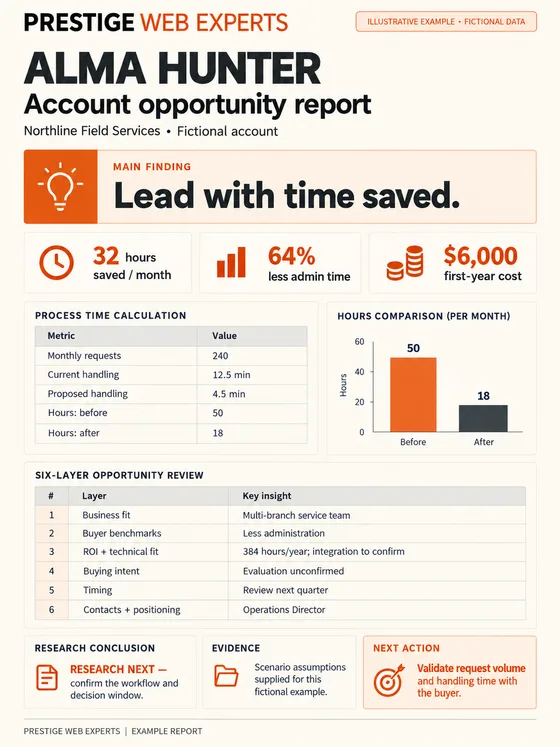
Account opportunity report
A six-layer fictional account brief with a time-saving hypothesis, evidence labels and unresolved buyer questions.Prescope new outbound accounts, a named target list or a scoped territory/CRM export for credible customer return, technical and channel fit, intent and timing—then tailor the contacts, messaging and positioning to your solution.
 Alma HunterIllustrative product scene
These are completed fictional examples. The figures show assumptions and the next decision—not a live result, public price or automatic product run.
Open example Account opportunity report
A six-layer fictional account brief with a time-saving hypothesis, evidence labels and unresolved buyer questions.Start with your business context, not generic assumptions.
Make the useful information clear and the next step practical.
Keep your team in control of the decisions that matter.
Software, commercial HVAC, industrial equipment, IT, contractors and consulting—each has its own dedicated Alma Hunter page and review brief.
Beyond lead generation: a customized qualification system built around what makes your offer worth buying. Use it to prescope one named account before outreach, or agree a managed volume review for a target list or CRM export.
Review industry, revenue, vertical, business model and sales channels before treating a company name as an opportunity.
Test money made, money saved or time saved against software, implementation, integration, marketing, people and ongoing operating costs. Show the assumptions instead of treating an estimate as a promise.
Check integrations, implementation constraints, delivery requirements and the commercial conditions each side would need before the account advances.
Look for relevant projects, decisions, evaluations or change signals. If the evidence is thin, keep the account conditional and name the question to validate.
Check project phase, purchase triggers and the likely decision window. A good account at the wrong time can be nurtured rather than pushed.
Identify economic, technical and operational decision-makers, then tailor a useful conversation to the account's situation and the evidence-backed customer-value case.
No supported way to make money, save money or save time—and no feasible implementation path—means there is no reason to advance.
Next gates: technical fit, buying intent, your timeframe and decision-maker fit.
The right people. A specific value case. Messaging built for them.
We sift for the signals that matter to your industry, economics and offer—not a pile of noise dressed up as a pipeline.
Sources, coverage and findings vary by brief, available evidence and search scope. The examples are illustrative—not live account results or a guarantee of buyer intent.
Do not treat a score as proof. Move an account forward only when the current evidence, assumptions and open questions support the next action.
Your success metrics should explain making money, saving money or saving time. We begin with your exact product page and one to three companies you say already get value. You review every public-page clue before it informs the draft; unknowns stay unknown.
Keep, edit, or remove each proposal. A customer example is a starting hypothesis, not general proof of fit or a customer outcome.
The original product, happy-customer, and account-test questions preserve the stated outcome, evidence, constraints, and explicit unknowns.
ICP, metrics, baselines, targets for making money, saving money or saving time, technical fit, deal value, research depth, and account volume are customer-supplied inputs for team review.
Pricing is determined by research complexity and volume. We review your ICP, qualification depth, markets, technical requirements and monthly account volume, then scope a custom quote. No fixed price or charge is generated from this form.
This is a buyer guide, not a public promise of a price, launch date, result, automatic integration or self-serve access.
How checkout works: A purchase action appears only when a verified active Stripe offer exists. Otherwise, submit a request below; it preserves Alma Hunterfor private team review and does not start paid work.
These are the KPIs this product is designed to help you track—not guaranteed performance claims.
Establish a baseline. Track changes. Review the result.
Establish a baseline. Track changes. Review the result.
Establish a baseline. Track changes. Review the result.
Paid offers appear here when their scope and price are approved. Alma Hunter pricing is determined by research complexity and volume—not a generic fixed package.
Start ICP-first onboardingPayment details are entered only on Stripe. We never collect card numbers in our forms.
This visual walkthrough uses fictional sample information. It does not invoke research, integrate a provider, create an account or produce a customer result.
 YOUR NEXT
Prescope a named account, target list or scoped CRM export against your exact ideal customer profile before outreach; CRM-wide volume is a managed scope, not an automatic run.
The report examples on this site use fictional data and say so. A customer story appears only after the customer, the claim and the publication terms are approved; no unnamed endorsement is used as a stand-in for evidence.
Request a fit conversation or complete the ICP-first onboarding. The team reviews the request and recommends the next scope decision. Required details are saved for private team review; a request does not create a purchase, provisioning or automatic outreach.
Alma HunterShare the decision and current context. We will review the request and respond with the next useful scope conversation.
Make the economics understandable with a real baseline and complete costs.
See what it doesTurn research into a buyer-specific discovery and executive conversation.
See what it doesCreate a focused audience message and a follow-up path worth responding to.
See what it does